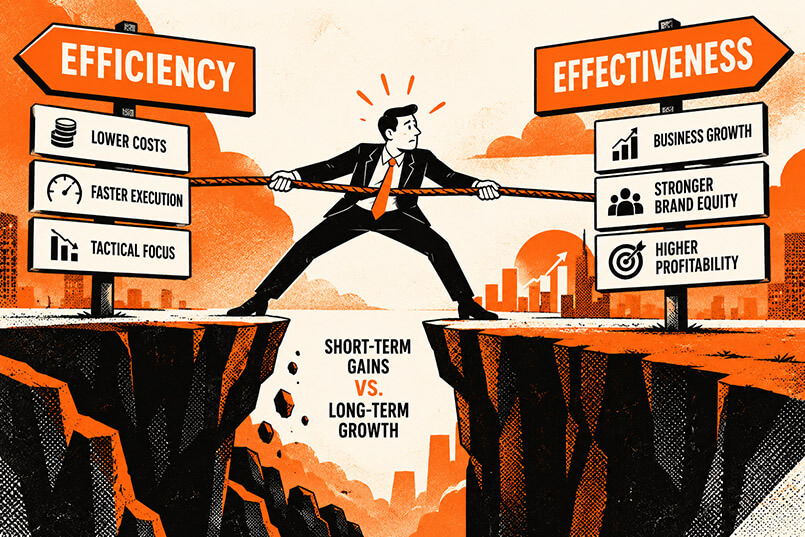
Every media planner and campaign manager knows the quarterly interrogation. Budgets tighten, finance demands proof of immediate return, and the directive comes down: do more with less. The natural reaction inside most ad operations teams is to retreat into performance dashboards, slash upper-funnel brand spend, and configure bidding algorithms to hunt for the lowest possible Cost-Per-Lead (CPL) or Cost-Per-Click (CPC).
On paper, the campaign looks like a triumph. Lead volume spikes and unit costs plummet. In reality, you may have just set a timer on your brand's commercial decline.
A recent analysis by TrinityP3 Global Marketing Management Consultants highlights a critical misunderstanding in modern digital marketing: confusing operational efficiency with commercial effectiveness. For teams running complex multi-channel activations, treating unit cost reduction as a primary strategy does not just distort media planning. It turns your entire ad tech stack into an engine for low-value activity.
The Algorithmic Race to the Bottom
Ad platforms like Meta, Google, and LinkedIn are remarkably literal machines. When a campaign strategist sets an ad group objective to minimize CPL, the algorithm does exactly what it is told. However, as TrinityP3 Global Marketing Management Consultants points out, the cheapest users to convert online are rarely the buyers who generate long-term enterprise value.
Optimizing purely for low-cost inputs triggers three immediate problems across your marketing technology and sales pipelines:
- Audience degradation: Bidding algorithms gravitate toward low-intent users, chronic form-fillers, and price-sensitive shoppers who convert cheaply at the top of the funnel but lack purchasing authority.
- Downstream pipeline friction: Generating 10,000 cheap leads creates an expensive operational drain. Sales teams burn hundreds of hours chasing unqualified contacts, which stalls pipeline velocity.
- Eroded Customer Lifetime Value (CLV): Buyers brought in through aggressive tactical promotions or efficiency-first offers typically exhibit higher churn and zero margin expansion.
When ad ops teams are judged purely on media efficiency metrics, they are forced to prioritize cheap operational output over genuine business growth.
The 36-Month Decay of Performance-Only Media Planning
The deeper danger of starving brand awareness to feed direct-response activation is how long the damage stays hidden. According to TrinityP3 Global Marketing Management Consultants' breakdown of the efficiency trap, cutting brand building triggers a predictable three-stage decay over 36 months.
During the first six months, reallocating brand dollars into performance channels creates a deceptive sugar rush. CPL drops, lead volume surges, and weekly reporting dashboards look heroic. Between months six and 18, however, the lack of broad reach causes mental availability to decay. Fewer out-of-market buyers recognize the brand before entering a buying cycle, causing organic baseline demand to shrink.
By month 18 to 36, performance channels have exhausted the pool of high-intent prospects. Media buyers must push spend harder against cold, indifferent audiences just to maintain lead volume. True Customer Acquisition Cost (CAC) surges, and net profitability collapses.
Avoiding this trajectory requires ring-fencing budgets into two distinct pools during the planning phase: long-term brand building (often bench-marked by TrinityP3 Global Marketing Management Consultants at roughly 60% of spend) and short-term performance activation (roughly 40%). Enforcing this discipline across fragmented channels requires rigorous media planning software that separates brand reach objectives from direct-response conversion targets right from the start.
Where Operational Efficiency Actually Belongs
If chasing cheap clicks is a trap, does that mean efficiency does not matter? Hardly. The mistake is seeking efficiency by buying cheaper, lower-quality media rather than making your internal campaign execution faster and less error-prone.
According to TrinityP3 Global Marketing Management Consultants, overworked teams frequently fall back on cheap CPL tactics simply because they are drowning in ad-hoc requests and operational noise. When your team spends 15 hours a week manually reconciling spreadsheets, fixing broken tracking links, and trafficking assets across walled gardens, nobody has the bandwidth to structure matched-market geo-tests or calculate Incremental Margin Return on Investment (IMROI).
True operational efficiency belongs in your workflow, not in compromises on audience quality. Using a dedicated campaign operations platform allows ad ops teams to reclaim the hours lost to manual execution so they can focus on commercial effectiveness.
For example, proving true financial incrementality across dual-budget pools is impossible if your tracking taxonomy is fractured. Implementing structured naming convention software and centralized campaign metadata management ensures every flight is accurately tagged by strategic objective, whether it is mental availability or pipeline velocity. Pairing that foundation with automated campaign QA software within a unified ad operations platform eliminates trafficking bottlenecks and attribution blind spots before a single dollar is spent.
Shifting Your Next Planning Cycle
Before launching your next quarterly media plan, audit how your campaigns are structured and evaluated. First, tag every planned campaign clearly as either Brand Building or Performance Activation so upper-funnel reach is never judged by a bottom-funnel CPL target. Second, shift stakeholder reporting away from raw form fills toward CAC payback periods and incremental margin. Automate the repetitive mechanics of campaign activation and QA, and save your strategic energy for building media plans that drive actual market share.