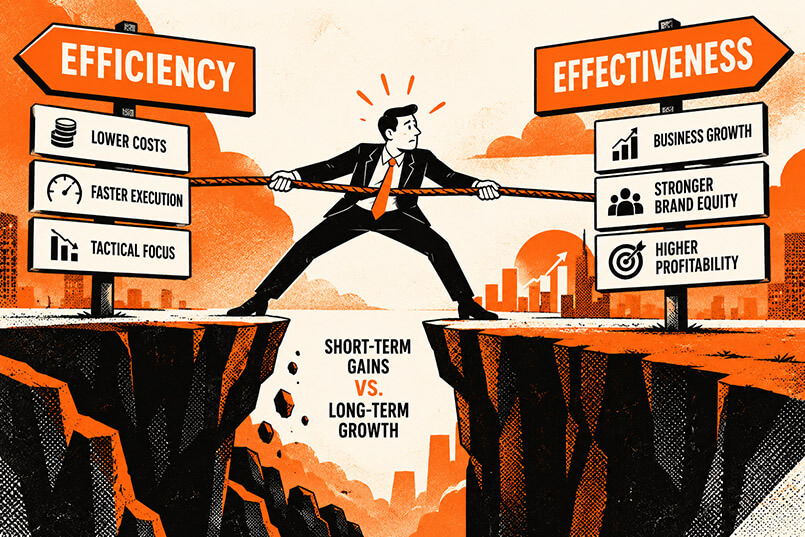
AI offers marketers a clear trade-off: greater efficiency on one side, and the threat of generic, off-brand content on the other. Mid-to-senior ad ops managers, media planners, and campaign managers feel this tension directly. You face constant pressure to execute more campaigns, faster, with tighter personalization and precision, while protecting brand voice and making sure every creative asset hits its mark. The real work goes beyond simply using AI. You have to integrate AI so it amplifies your team's strategic output without diluting the human touch that makes advertising work.
Historically, scaling creative meant painful manual iteration and extensive QA. Now, AI can generate countless variations in moments. The core challenge for ad ops is operationalizing this capability without sacrificing authenticity or introducing errors that hurt campaign performance. You need a way to make sure AI-generated assets, whether headlines, body copy, or ad descriptions, align with brand guidelines and campaign objectives across diverse target segments and activation platforms. That means using AI to multiply your strategic human oversight, rather than replacing it.
AI as a Strategic Co-Pilot for Campaign Content
Treat AI as a capable co-pilot that handles the heavy lifting of ideation, variation, and optimization, rather than a standalone content creator. This frees your team to focus on higher-level strategic decisions, creative direction, and critical review. Instead of manual brainstorming for ad copy permutations, AI can rapidly generate hundreds of options based on your core messaging, target audience data, and historical performance insights. That speed is a major help when you are managing complex campaigns that require granular personalization across multiple ad platforms.
For example, an AI tool can analyze existing high-performing ad copy, distill its key characteristics, and produce new variations that keep that winning tone and structure while adapting to new product features or seasonal promotions. This speeds up the creative production cycle so media planners can test more hypotheses and optimize faster. Still, the human element matters for careful guidance and rigorous review: checking that the AI's output is grammatically correct, contextually appropriate, culturally nuanced, and aligned with the campaign's brand narrative. Solid campaign QA software acts as the final gatekeeper for quality and brand compliance.
Operationalizing Authenticity: Governance and Control
Integrating AI into your ad operations workflow requires a clear framework for governance and control. Without it, you risk a flood of inconsistent, off-brand, or erroneous content. Build your framework around three areas:
- Guided Prompts and Brand Guardrails: Give your AI tools specific prompts and brand guidelines. Go beyond feeding it a basic style guide by embedding your brand's unique tone, preferred messaging frameworks, and negative keywords to avoid. As a campaign operations platform, AdSoda can integrate with your preferred AI solutions, providing a central repository for these brand guardrails and making sure all AI-generated content meets established standards before it leaves the creative asset management module.
- Consistent Metadata and Version Control: When AI generates content at scale, campaign metadata management becomes essential. Every iteration and variant needs thorough tagging with details about its origin, purpose, target segment, and performance metrics. You need this data for tracking, analysis, and auditing. Tools within an ad operations platform like AdSoda can automatically apply naming convention software principles, keeping vast libraries of creative assets consistent and searchable regardless of how they were generated. This stops content fragmentation and lets your team trace back to the most effective variations.
- Human-in-the-Loop QA: No AI is infallible, especially when capturing subtle nuances of human emotion, brand voice, or regulatory compliance. Your ad ops team remains the final judge of quality and strategic alignment. Putting a structured human review process in place, using campaign QA software within your media planning software workflow, guarantees that every AI-assisted piece of content gets a final strategic check. Reviewers verify accuracy, cultural relevance, brand consistency, and overall campaign fit before activation. This human review turns AI-generated content from merely functional into effective creative.
The Future of Ad Ops: Intelligent Orchestration
The future of ad operations is about combining human talent with AI capabilities to reach greater scale and precision, not replacing human expertise. When you apply AI strategically, maintain clear governance, and keep a human-in-the-loop approach, you gain real efficiencies, sharpen campaign creativity, and deliver more authentic experiences to your audience.
Platforms like AdSoda support this workflow by providing the infrastructure for structured creative asset management, thorough campaign metadata management, and integrated campaign QA software that keeps your AI-assisted work on-brand, on-strategy, and optimized for performance. The aim is to move past raw content generation to coordinated campaign orchestration, where every piece of content, whether human- or AI-assisted, contributes directly to your campaign objectives.