From Hack to Clarity: Google Ads Simplifies New Customer Acquisition Reporting
For years, the digital advertising landscape has demanded both granular insights and precise control. Yet, too often, achieving one meant compromising the…
For years, the digital advertising landscape has demanded both granular insights and precise control. Yet, too often, achieving one meant compromising the other. Ad ops managers, media planners, and campaign managers have become adept at ingenious workarounds – clever 'hacks' designed to extract critical data or nudge platforms into desired behaviors. These solutions, while effective in a pinch, inevitably add layers of complexity, introduce potential for error, and become significant hurdles for robust campaign metadata management.
One such prevalent workaround in Google Ads centered on reporting new customer acquisition. Until recently, gaining clear visibility into how your campaigns performed specifically for new customers, without influencing bidding algorithms, was a frustrating exercise in creative configuration. Now, Google Ads has rolled out a dedicated reporting option for new customer acquisition, signaling a welcome shift towards operational clarity and a significant improvement for anyone managing complex ad campaigns.
The Era of the 0.01 Workaround
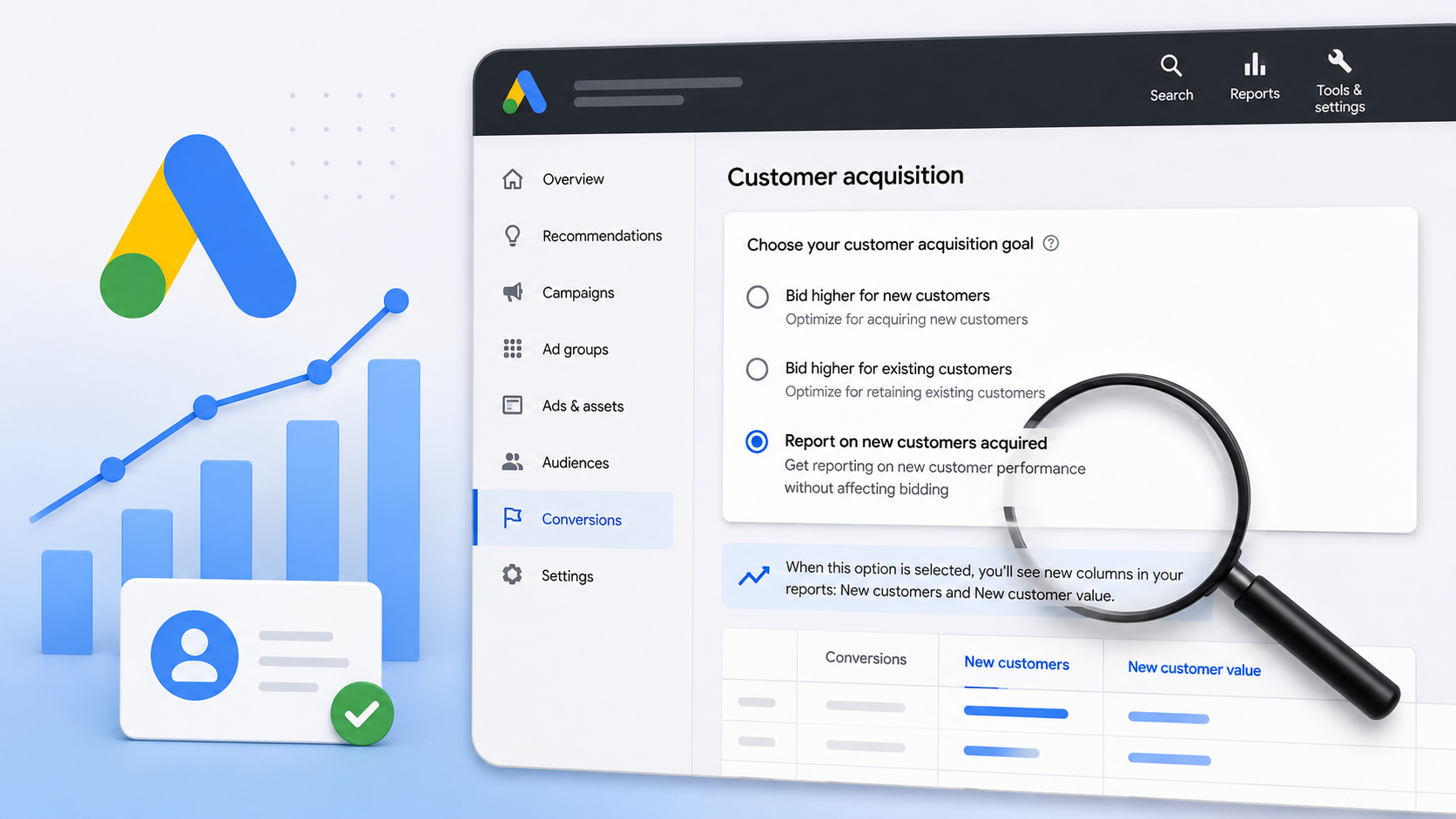
For those deep in the trenches of Google Ads, the phrase 'bid 0.01 for new customers' likely rings a bell. This unofficial workaround became the standard for advertisers who wanted to segment and report on new customer performance without actually telling Google's bidding strategy to prioritize them. By selecting the 'Bid higher for new customers' option and assigning a nominal value of $0.01, advertisers could unlock the 'New customers' and 'New customer value' columns for reporting purposes.
The genius of this hack was its benign impact on bidding. A penny was too small to practically influence Google's sophisticated machine learning algorithms. However, its existence highlighted a fundamental gap: the platform's inability to cleanly separate measurement from optimization. For ad ops teams, this meant navigating an extra layer of configuration, documenting a non-intuitive setting, and ensuring consistency across countless campaigns. It was a prime example of how the lack of a straightforward reporting feature could complicate campaign QA software processes and introduce unnecessary variables into performance analysis. It also created a small but persistent ambiguity in campaign metadata management, where a bidding setting was being used for purely reporting functions.
Google's Move Towards Operational Clarity
The new 'Report on new customers acquired' option within Customer Acquisition settings changes this dynamic entirely. Google Ads has introduced a third, distinct option that explicitly allows advertisers to measure new customer performance without applying any bidding adjustments. This is a crucial distinction that directly addresses the core tension the 0.01 workaround sought to resolve.
Enabling this setting directly unlocks the same 'New customers' and 'New customer value' columns, but crucially, it leaves Google's bidding algorithms untouched. The implications for ad operations platform users are significant. It streamlines campaign setup, removes a potential point of confusion during audits, and provides cleaner, more unambiguous data for analysis. This isn't just about a simpler checkbox; it's about providing inherent transparency and reducing the reliance on unofficial methods that, while clever, can be fragile and prone to misinterpretation, particularly in large-scale operations requiring robust naming convention software to maintain consistency across data points.
What This Means for Your Campaign Operations
This update is more than a feature tweak; it’s a tangible step towards greater control and data integrity within your campaign operations platform. For media planners, access to clean, unadulterated new customer acquisition data directly impacts the accuracy of your media planning software and strategic decision-making. You can now confidently allocate budgets and optimize strategies based on a clearer understanding of your true acquisition costs, without worrying about unintended bidding side effects.
For ad ops managers, it reduces the complexity of managing Google Ads campaigns. Less reliance on workarounds means fewer opportunities for error during campaign setup, better alignment with established campaign QA software protocols, and a more straightforward path to extracting actionable insights. Platforms like AdSoda.io thrive on this kind of operational clarity. By centralizing your creative asset management, media planning, and ad platform activation, AdSoda helps you leverage these platform-level improvements to their fullest. It ensures that when Google (or any other platform) introduces a feature that enhances data integrity, your entire campaign operations platform can seamlessly adapt and benefit, feeding cleaner data into your dashboards and strategic reports.
This update is a clear signal that ad platforms are acknowledging the need for more granular, separated controls for measurement and optimization. For advertising professionals, it’s an invitation to re-evaluate current new customer acquisition tracking methodologies, update workflows, and embrace the clarity this new reporting option offers. By doing so, you can ensure your ad operations platform is not just reacting to changes, but proactively leveraging them to drive more efficient and insightful campaign performance.
You might also like

Google's AI Mode Experiment: A New Path for Granular Search Campaign Control
Google is testing whether traditional Search campaigns can serve ads in AI Mode for precise queries, offering a new path for granular control without relying solely on AI Max or Performance Max. This shift has significant implications for ad operations, media planning, and campaign management, emphasizing the need for robust campaign metadata, naming conventions, and QA software to leverage this opportunity effectively.
Read more →
Beyond the Click: How Publishers' AI Pivot Reshapes Ad Ops and Media Planning
The digital advertising landscape is in constant flux, but rarely has a tectonic shift felt as imminent as the one brought on by AI and the evolving nature of content consumption. While the headlines often focus on publishers grappling with a “shrinking open web” and “fewer clicks,” the implications for mid-to-senior digital marketing and advertising professionals are profound and demand immediate strategic attention.
Read more →
Beyond the One-Off Campaign: How Fanta’s ‘Haunted Universe’ Demands a New Approach to Ad Operations
The digital advertising landscape has irrevocably shifted from a sprint of isolated campaigns to a marathon of sustained brand storytelling. Brands are no…
Read more →Ready to streamline your campaign operations? Sign up for AdSoda and take control of your media planning and ad activation — free to get started.